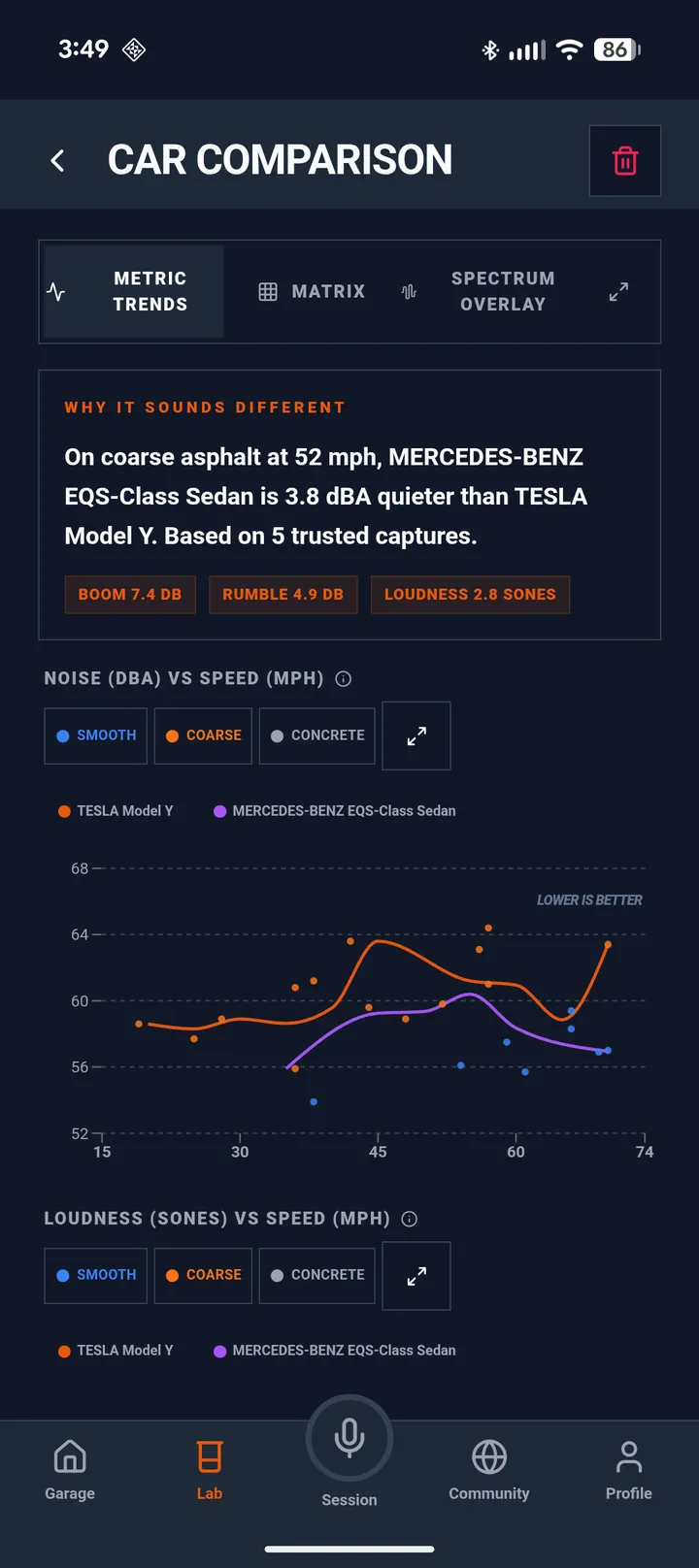
A phone will not turn your driveway into an acoustic laboratory. It can still answer a very useful question: did your own car change after new tires, a repair, sound treatment, or the arrival of an unfamiliar noise?
Choose one familiar test
Pick a road you drive regularly and a speed you can hold safely and legally. The goal is not to find the quietest possible stretch. The goal is to choose a drive you can repeat later.
Before moving:
- secure the phone in the same holder and orientation each time;
- close the windows and set the HVAC consistently;
- note the tires, pressure state, passengers, and unusual cargo;
- let a passenger operate the app.
Record two or three normal runs
In NVH Lab, add your car and start a Drive Test. Record the same stretch more than once if traffic and conditions allow. A truck passing beside you or a rough patch of asphalt can distort one run; repetition makes those moments easier to spot.
Save the road surface and speed range with the test. Do not chase a perfectly steady number while driving. The app records the result so you can inspect it after the car is parked.
Repeat it after something changes
Use the same phone, holder, route, speed, and HVAC setting after the next tire change, repair, or modification. Compare the new Drive Test with the old one in your Garage.
Look for a change that repeats, not a single decimal. Did the whole cabin become louder? Did one narrow tone appear? Did the improvement only show up on smooth pavement? Those observations are more useful than an isolated peak value.
Use similar cars as context
The Website checker can show whether community Drive Tests exist for your model and driving conditions. Treat a small sample as a starting point. Your own before-and-after history is usually the stronger comparison because the phone, placement, and car stay the same.
Understand the limit of the phone
Microphones and automatic processing differ between devices. A phone is best for relative tests with the same device. It is not a substitute for a calibrated meter when legal, occupational, certification, or engineering accuracy is required.
For an example of a phone app with published laboratory validation, read the official NIOSH Sound Level Meter guidance. NIOSH designed that app for workplace sound exposure, not vehicle diagnosis, but its documentation is a good reminder to be cautious with absolute phone readings.
Your first result is a baseline
The most valuable recording may be the one you make before anything seems wrong. Save one familiar drive now. When the car changes later, you will have something real to compare it with.